

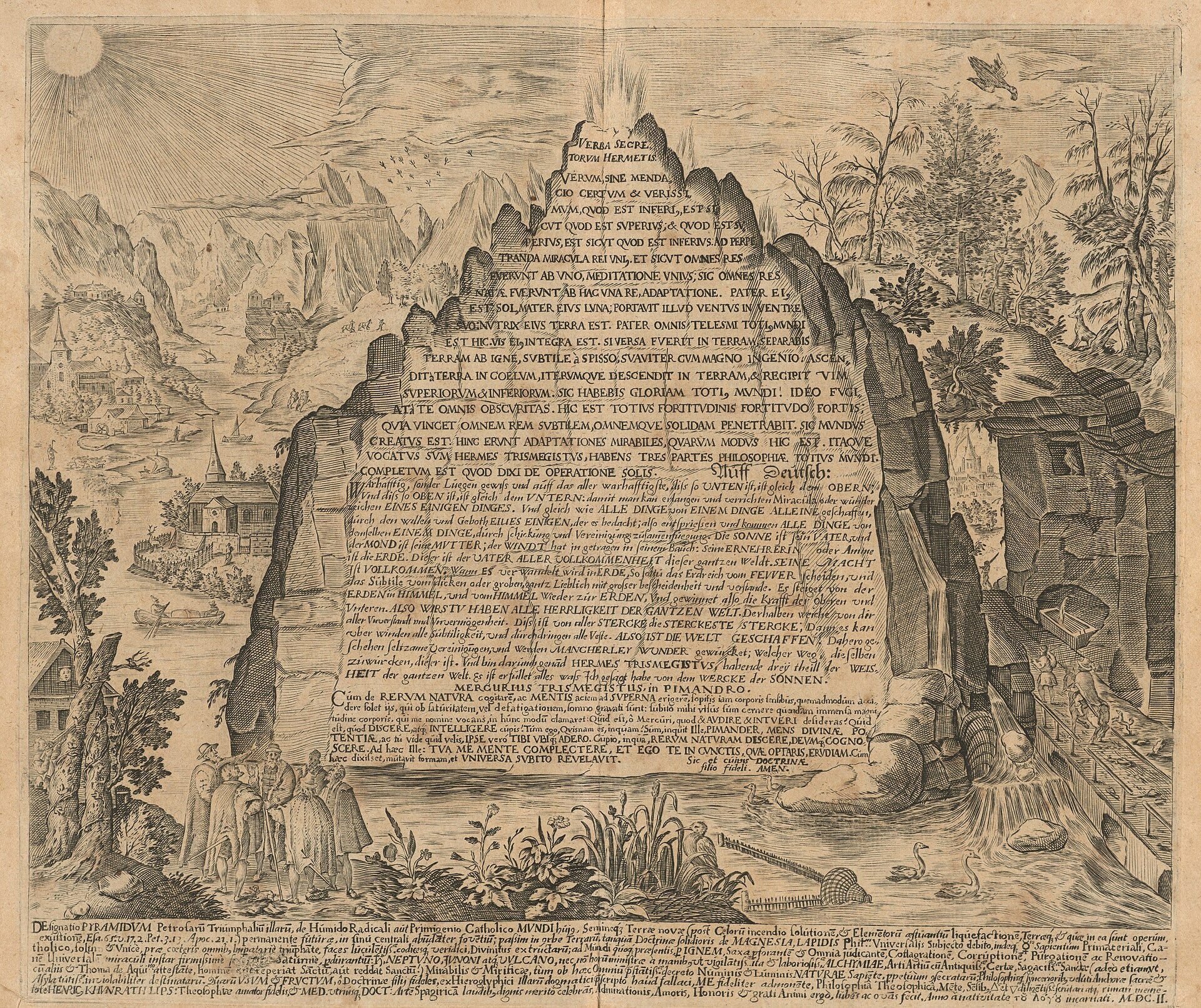
In the library of King’s College, Cambridge, there is a small bundle of papers cataloged as Keynes MS 28. On one sheet, in brown ink, Isaac Newton wrote out an English translation of a very short text. It begins:
“Tis true without lying, certain & most true. That which is below is like that which is above & that which is above is like that which is below to do the miracles of one only thing.”
Then come lines that read like a riddle: “The Sun is its father, the moon its mother, the wind hath carried it in its belly, the earth is its nourse.” The reader is told to “separate thou the earth from the fire, the subtile from the gross sweetly with great indoustry.” A short line follows, “So was the world created.” It ends with the speaker naming himself: “Hence I am called Hermes Trismegist, having the three parts of the philosophy of the whole world.”
This is the Emerald Tablet, or Tabula Smaragdina. It runs to about a dozen lines. For centuries alchemists treated it as the founding document of their art, a recipe for the philosopher’s stone written in riddles. Its second line, boiled down to “as above, so below,” has become one of the best-known phrases in Western esotericism. The man who wrote the Principia took it seriously enough to translate it and write a commentary on it.
The Tablet came wrapped in a story. In the most famous versions, it was found in the tomb of Hermes Trismegistus, the “thrice-great” sage whom later writers blended from the Greek god Hermes and the Egyptian god Thoth. It was an actual tablet of emerald, the legend said, carved with these words by Hermes himself. Greek texts credited to Hermes had circulated in Roman Egypt since the first century BCE, and by the tenth century some Arabic-speaking Muslims identified him with the prophet Idris. A text from Hermes carried enormous authority.
The tomb legends
The discovery story changed with every telling. A book of 1496 by Hieronymus Torrella had Alexander the Great find the tablet in Hermes’ tomb on his way to the Oracle of Amun in Egypt. In 1617 the alchemist Michael Maier repeated that version.
Other writers moved the tomb. A legend traced in Wikipedia’s account of the Tablet placed the discovery in the Hebron Valley after the biblical Flood. In 1733 a supplement to an alchemical work called the Golden Fleece added a woman named Zora, who finds “a precious emerald plaque” in Hermes’ grave at Hebron.
The Tablet even acquired a picture. From the late sixteenth century, printers paired it with an emblem: the sun and moon pouring into a cup, the planets around it, and a ring of Latin words, Visita interiora terrae rectificando invenies occultum lapidem, roughly “visit the interior of the earth, and by rectifying you will find the concealed stone” (our translation). The first letters spell VITRIOL. Over time the emblem came to be treated as a picture of the Tablet itself.
The Tablet’s reputation spread with these stories. Medieval commentators such as Hortulanus interpreted it as instructions for making the philosopher’s stone and turning base metal into gold. Renaissance writers read it as philosophy, even as a mirror of the Book of Genesis. Nicolas Flamel, the Paris scribe later turned into a legendary alchemist, belongs to the same world of borrowed authority. We first looked at the Tablet’s alchemy in our earlier article on the Emerald Tablet.
By the seventeenth century there were doubters. Isaac Casaubon’s study of the Hermetic writings cast doubt on the antiquity of Hermes himself. In the 1650s the scholar Athanasius Kircher rejected the Tablet’s attribution outright, arguing that its “barbaric” Latin pointed to a much later origin and that no ancient Greek writer ever mentioned it. Yet for all that time, the oldest copies anyone in Europe knew about were Latin, dating to the twelfth century. Nobody had seen an emerald, a tomb or anything older.
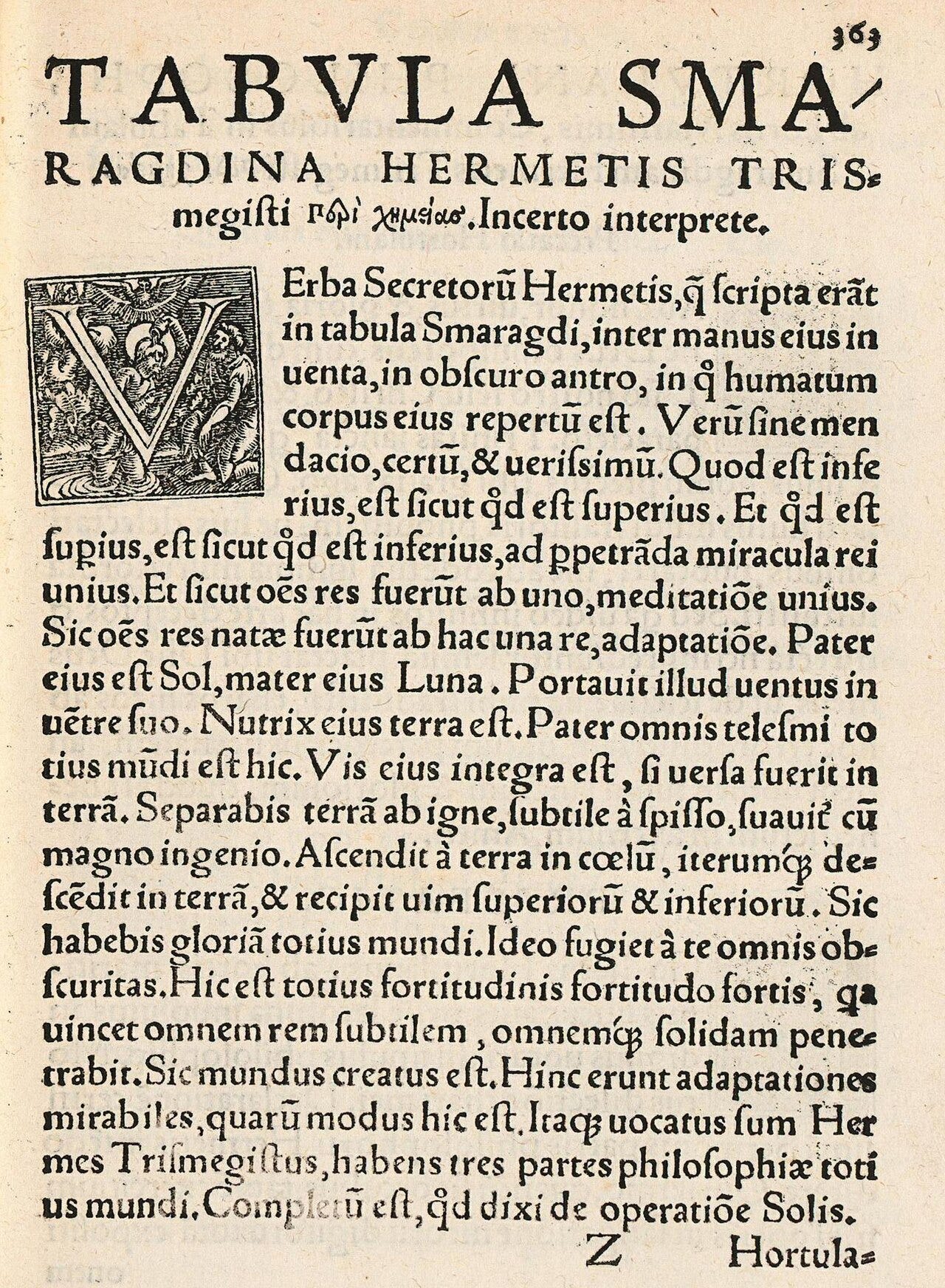
Then, in the 1920s, two scholars working on medieval manuscripts, Eric John Holmyard and Julius Ruska, found the Tablet in far older forms. They were in Arabic. And the oldest of them sat inside a book that bore the name of a Greek wonder-worker from the first century.
This is a paid post. The rest of the story, including the Arabic book where the Tablet first appears, the man in its frame story, the Latin mistranslation that alchemists argued over for centuries and what Newton’s own manuscript tells us, continues below for paid subscribers. Subscribe to Historic Mysteries to read it and the full archive.
