



We are taught to believe we are alone - the first and only advanced civilization ever to grace this planet. Yet scattered across continents from the deserts of Mesopotamia to the forests of India lies a puzzle that refuses to fit into conventional history: vast regions of vitrified stone, ancient texts describing weapons of unimaginable destruction, and ruins so thoroughly melted that they defy explanation by any known natural phenomenon.
When the first atomic bomb lit up the New Mexico desert in 1945, scientists made a chilling discovery - the resulting glass fragments were identical to tektites, mysterious artifacts found worldwide and dated to 700,000 years ago. Could it be that we are not the first to split the atom? Could advanced civilizations have risen before us, only to annihilate themselves in a thermonuclear apocalypse so complete that history itself was erased?
Before the First Human Dawn
When did humanity as we know it come into being? Science preaches that life began in the primordial cauldron when it says Mother Earth was in her infancy.
Several generations of secular scientists have taught that billions of years ago lightning bolts struck puddles of naturally occurring chemicals, and that this somehow produced the first reproducing life forms. Through the mysterious nuances of a still-young discipline called evolution, these primeval, simple organisms supposedly developed, becoming more and more complex through eons, with innumerable life forms becoming extinct along the way until modern humans appeared.
Yet the disciples of this godless gospel are terribly embarrassed when asked why, if this monumental act of creation started out with such humble equipment as lightning and mud puddles, they cannot duplicate it in their state-of-the-art laboratories. Nor can they explain why it is not still continuing. Perhaps the time has come to look elsewhere for an answer.
In the Beginning
The Bible, naturally, has a different spin on things. Genesis 1:1 tells how God created the heavens and the Earth, but the human race as we know it today is not mentioned as being fashioned until chapter 2, verse 7.
And here is the key question: if orthodox science cannot even clarify the creation and proliferation of life, how can it be certain Homo sapiens are the only sentient life form this planet has ever supported? If we use the Bible as a template, how much time may have elapsed between Genesis 1:1 and Genesis 2:7, and what self-aware creatures may have flourished in this period?
Although artifacts indicating prehistoric, technologically advanced civilizations do exist (chagrined paleontologists call them “erratics”), discussing the likelihood of such antediluvian cultures is not the subject of this writing. What is to be discussed here is what may have happened to them. We find hints from antiquity.
Back in the USSR
When the Eastern Bloc collapsed in 1991 the whole world breathed a sigh of relief. The decades-old threat of a global nuclear war seemed to have passed. Yet what if the East-West rivalry had not ended with a whimper? What if it had ended with a bang?

Considering the destructive potential of the atomic arsenals produced and stockpiled by the superpowers, our world could well have been reduced to irradiated charcoal by thermonuclear war, had the United States and Soviet Union decided to settle their differences in this fashion. The human race could easily have been annihilated, and Mother Earth left in a state too radioactive to support higher life forms for tens of thousands of years. It didn’t happen, but it could have, and the possibility certainly still exists today.
Pertinent here is the question of whether such an event could have happened before? Did an advanced civilization (perhaps of humans) exist on Earth before, but some catastrophic event annihilated them? The signs are not that hard to read for those willing to interpret them for what they seem to be.

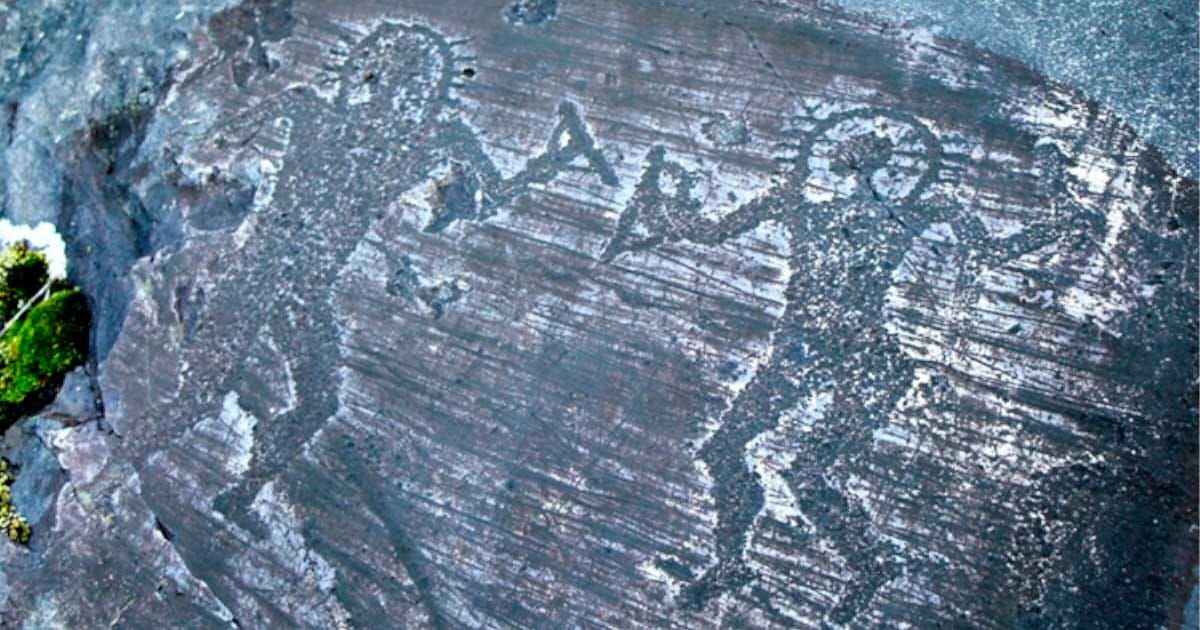
#/media/File:Antropomorfi_detti_astronauti_(a)_-_R_1_-_Area_di_Zurla_-_Nadro_(ph_Luca_Giarelli).jpg)
