


In the 3rd arrondissement of Paris, at 51 rue de Montmorency, there is a very old house with an inscription carved across its front. English Wikipedia gives it in translation: “We, plowmen and women living at the porch of this house, built in 1407, are requested to say every day an ‘Our Father’ and an ‘Ave Maria’ praying God that His grace forgive poor and dead sinners.”
The man who built it is far more famous than the house. Readers of Harry Potter and the Philosopher’s Stone know him as the ancient wizard who made the stone. The Church Monuments Society notes that J.K. Rowling did not invent the name. Nicolas Flamel and his wife, Pernelle, were real people in medieval Paris.
French Wikipedia calls him the most popular of French alchemists. The legend says he learned how to turn base metal into gold, used his fortune to build hospitals and churches, and never died.
This autumn, the Musée de Cluny in Paris opened an exhibition about him called Nicolas Flamel, alchimiste de papier, “the paper alchemist.” It runs from 13 October 2026 to 24 January 2027. The title is a clue.
The legend, as it was told
The full story first appeared in print in Paris in 1612, in a book called Trois traitez de la philosophie naturelle, published under the name of Pierre Arnauld, sieur de la Chevallerie. Among the texts was one presented as Flamel’s own account, Les figures hiéroglyphiques de Nicolas Flamel, explaining the pictures he had supposedly placed on an arch in the Cemetery of the Holy Innocents.
In it, Flamel tells how he bought, for two florins, an old Latin book made of “three times seven” leaves of bark, bound in a copper cover “engraved all over with letters and figures” (our translation). Its title page named its author as Abraham the Jew, prince, priest, Levite, astrologer and philosopher.
The book explained metallic transmutation. But the key first ingredient was shown only in pictures, and Flamel could not understand them. With Pernelle’s help, he worked for twenty-one years and failed.
So he set out on pilgrimage to Santiago de Compostela. There, the story says, he met an old physician, a Jewish convert to Christianity, who at last explained the pictures. Back in Paris, Flamel first turned mercury into silver, and then, on 25 April 1382, projected the red stone onto mercury and “truly transmuted” it into “almost as much pure gold, better certainly than common gold, softer and more pliable” (our translation).
With the fortune that followed, the book says, Flamel and Pernelle “founded and endowed fourteen hospitals in this city of Paris, built three chapels from new, and decorated seven churches with great gifts and good rents” (our translation).
Once the book was out, the stories multiplied. In 1655, French Wikipedia says, the physician Pierre Borel recorded rumors that King Charles VI had sent an official to look into Flamel’s wealth, that Flamel bought his silence with a flask of the powder of projection, and that Cardinal Richelieu had found the Book of Abraham shortly before his death in 1642.
Not everyone was fooled. The Paris historian Henri Sauval mocked the hermetic philosophers who “have meditated so much on some portals of our churches that in the end they found there what they were looking for” (our translation). Isaac Newton, in his alchemical studies, took an interest in the “hieroglyphs” of the Flamel books. By 1721, Montesquieu was joking about a man ruining himself in pursuit of “this secret, which Nicolas Flamel found” (our translation), in his Persian Letters.
Then came the sightings. The belief that Flamel and Pernelle were still alive, French Wikipedia notes, appeared in the age of the Count of Saint-Germain, who passed himself off as immortal and was the subject of our post on Tuesday. In 1712, the royal antiquary and traveler Paul Lucas reported, without quite believing it, that a dervish he met in Turkey told him the philosopher’s stone could extend life by a thousand years. As proof, the dervish said he had met Flamel in India three years earlier. Pernelle had not died in 1397 either, he claimed. She had moved to Switzerland, and her husband had joined her in 1418. By 1761, French Wikipedia says, people were telling of the couple being seen at the Paris opera with their son.
It is a wonderful story. The problem is the man in the documents. He left a paper trail, and it describes someone very different. As for the book that made him famous, it contains clues that it could not have been written in his lifetime, and at least one scholar has a strong suspicion about who really wrote it.
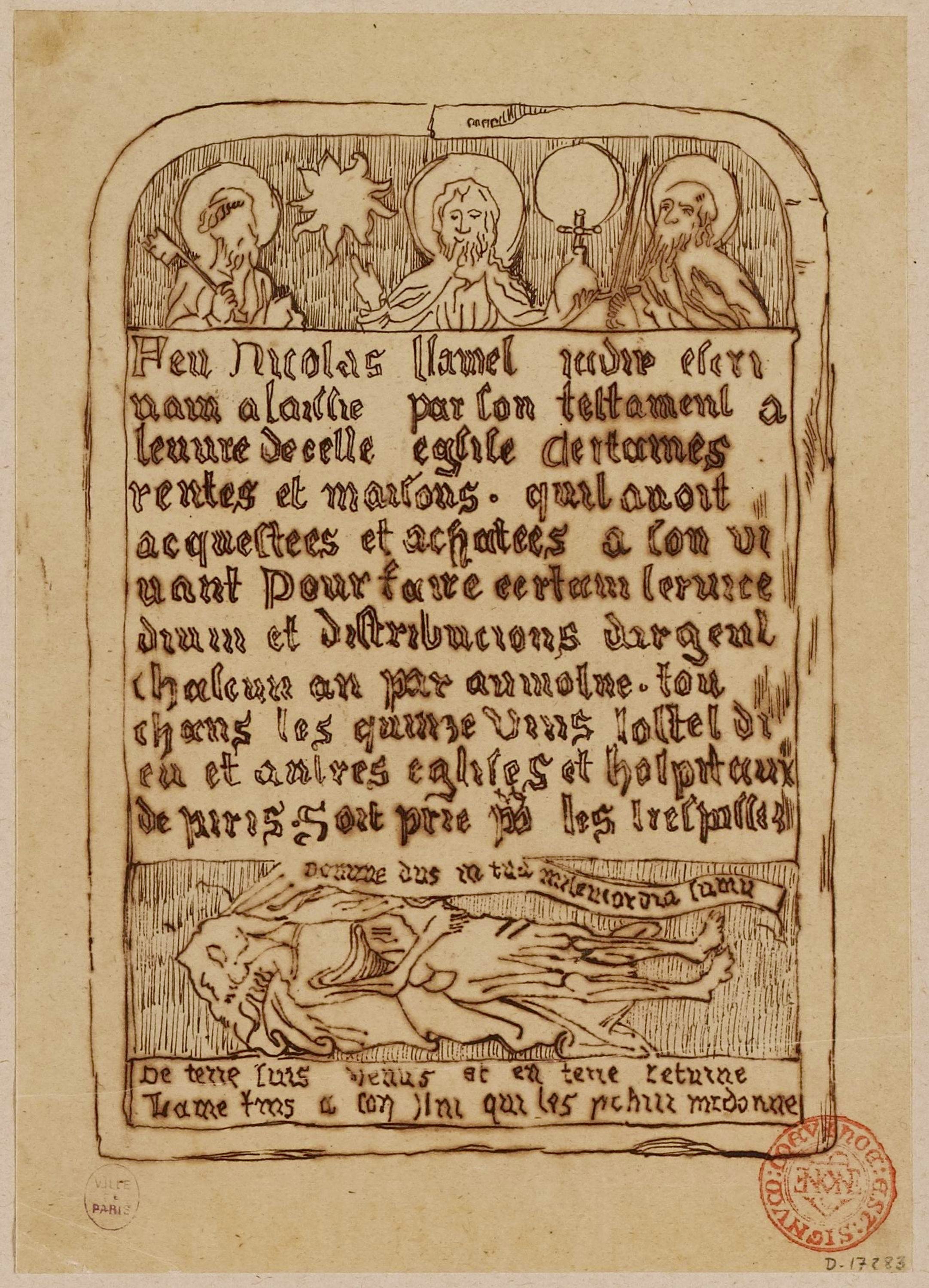
This is a paid post. The rest of the story, including the real Flamel’s career, his wife’s lawsuit, his four wills, the tombstone that became a market stall, and how a forged book was built from older texts, continues below for paid subscribers. Subscribe to Historic Mysteries to read it and the full archive.
