


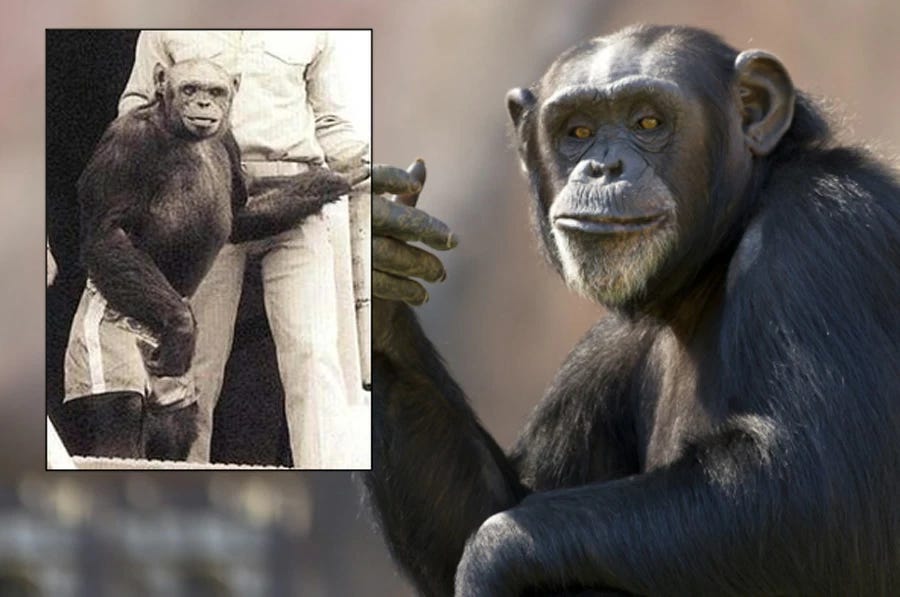
For a century, whispers of a human–ape hybrid have flickered at the edges of science and spectacle. Then came Oliver: a soft‑voiced, upright‑walking chimp with a strikingly humanlike face who drank coffee, mixed cocktails, and captivated audiences as a supposed “missing link.” His journey—from TV novelty to laboratory cage to a peaceful sanctuary—and the tests that ultimately revealed he was no hybrid at all, expose a deeper story: the power of mutation, the pull of myth, and the ethical cost of turning a sentient life into a curiosity.
Fascination With the Great Apes
There have been many experiments in the past designed to understand the connection between humans and our closest relatives, the great apes. In fact, scientists have time and again tried to create a hybrid of humans and apes, theorizing that the close DNA match might make this viable. In 1929, Soviet scientist Ilya Ivanovich Ivanov apparently came very close to creating a human-ape hybrid. Even though there is considerable curiosity around creating a hybrid of man and ape, there are many skeptics in the scientific world.
Concerned by his experiments, authorities became alarmed of the prospects of a “humanzee” hybrid. To avoid the possibility of creating such a creature, and what it would mean for society and our place in the universe, Ivanov was sent to exile in Kazakhstan in 1930, where he died a couple of years later. But the experimentation did not end there.
