


Early on the morning of 15 September 1613, a prisoner died in the Tower of London. A jury of warders and fellow prisoners at once found that he had died of natural causes, and he was buried in the Tower church that same afternoon, between three and four o’clock. That, at least, is how the Victorian Dictionary of National Biography tells it. Wikipedia gives the date of death as 14 September, and the sources still differ.
The dead man was Sir Thomas Overbury, poet, courtier and for years the closest adviser of King James I’s favorite. For nearly two years, the full story stayed out of sight. When the truth came out, it brought down the favorite, sent four people to the gallows, and left the king suspected of protecting murderers.
It is England’s answer to the Borgias: a story of court factions, a forced annulment, an astrologer’s love charms, and poison delivered in sweets.
The governor of the favorite
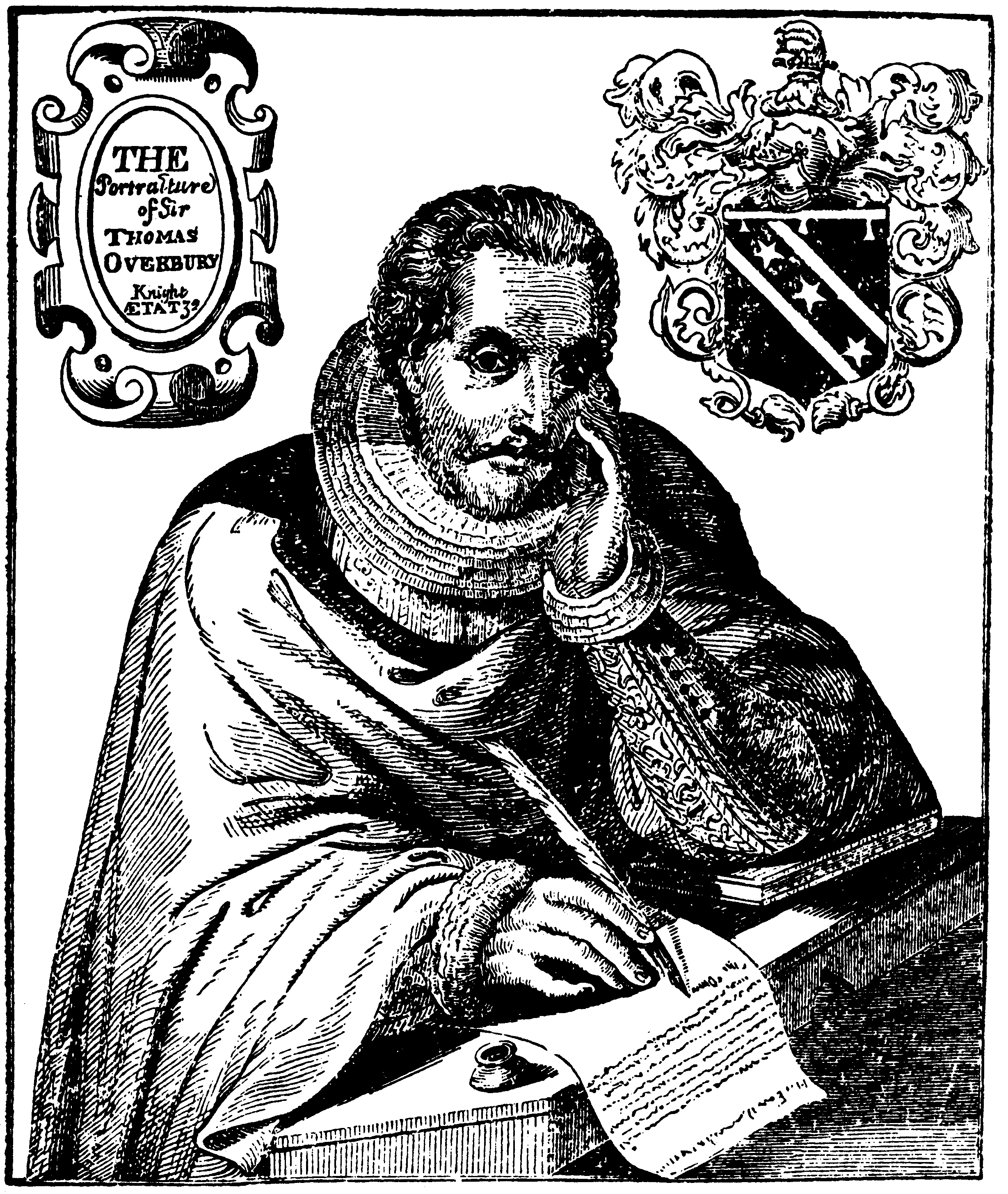
Sir Thomas Overbury, in an engraving labelled “The Portraiture of Sir Thomas Overbury, Knight, aetat 32,” as published in Charles Mackay’s Extraordinary Popular Delusions and the Madness of Crowds. (Image: Wikimedia Commons, public domain)
Overbury met Robert Carr in Edinburgh around 1601, when Carr was a page to the Earl of Dunbar, according to the Dictionary of National Biography. The friendship deepened when Carr arrived in London in attendance on James I in 1603. Britannica says Carr first attracted the king’s interest in 1607 and was his favorite until 1615.
Carr, “conscious of his defective training and education,” as the DNB puts it, found in Overbury an invaluable adviser. The same source says Queen Anne nicknamed Overbury Carr’s “governor,” or tutor, and that she probably described their relationship truly. Overbury was knighted at Greenwich on 19 June 1608.
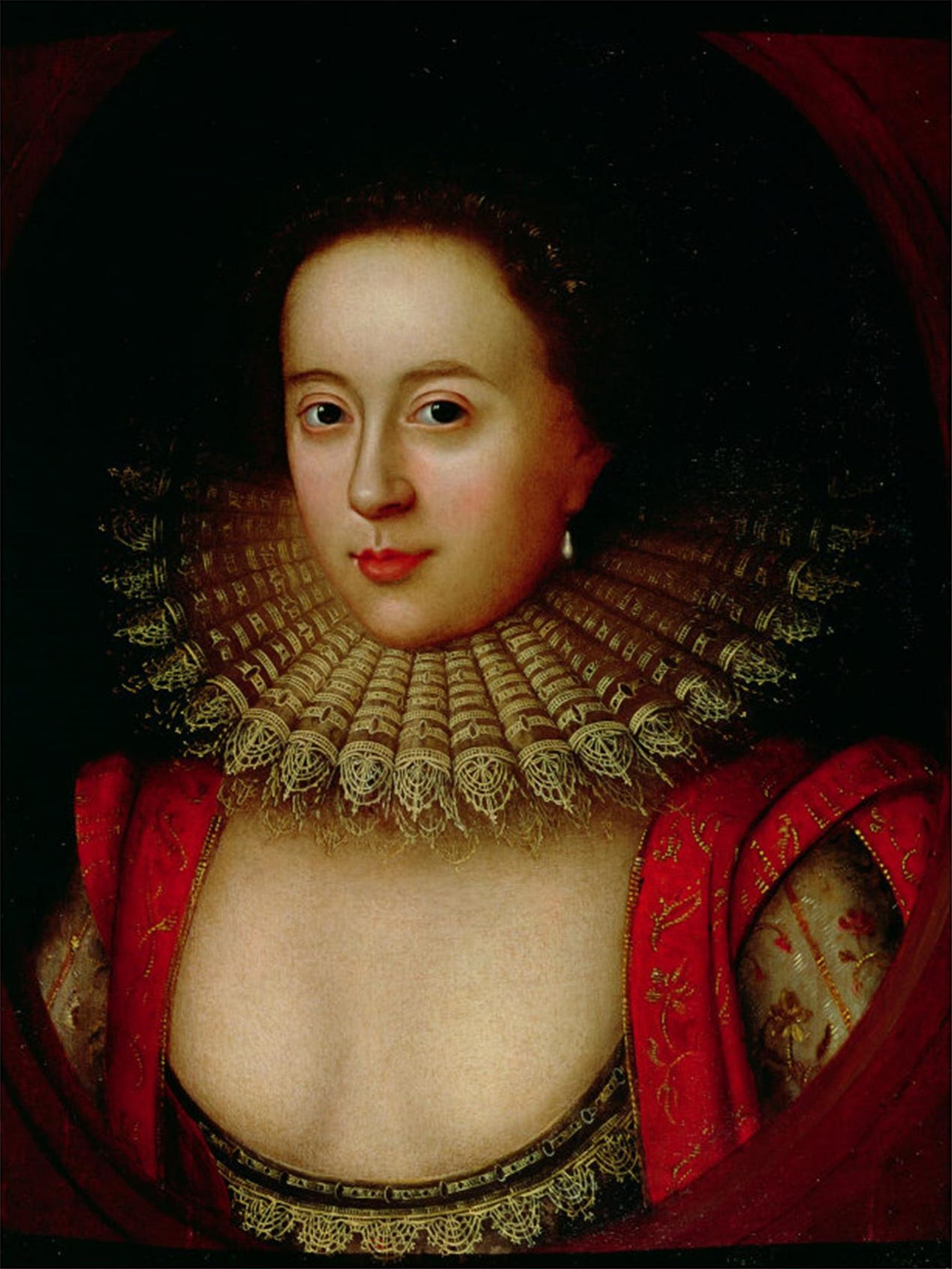
Then Carr fell in love with Frances Howard, Countess of Essex. She was born in 1590, according to Wikipedia, and had been married to the young Earl of Essex at the age of 14. Her family, the Howards, led a faction that, Wikipedia says, moved to take control of much of the government after the death of Robert Cecil in 1612.
At first Overbury helped the affair along. The DNB says he wrote many of the poems and letters with which Carr wooed the countess. But marriage was another matter. The DNB says Overbury “had no doubt whatever of her unfitness to become Rochester’s wife” (Carr was then Viscount Rochester), and passionately urged him to break with her.
Into the Tower
The Howards wanted Overbury gone. The DNB says the king was persuaded to offer him a post abroad. Sources disagree on which one. Sir Ralph Winwood’s Memorials speak of an embassy in France or the Low Countries, while the letter writer John Chamberlain and the diarist Sir Simonds D’Ewes mention Russia. Overbury refused.
The refusal gave his enemies their excuse. In the DNB‘s account, on 26 April 1613, “about six o’clock in the evening,” Overbury was taken from the council chamber to the Tower “as close prisoner.” Wikipedia gives 22 April. Britannica says he was imprisoned “on a charge of treason.”
With Overbury out of the way, the Howards moved fast. Frances sought an annulment of her marriage to Essex on the grounds of his impotence, which he denied. Wikipedia says the commissioners split five to five, and that James added two judges who could be relied on to vote yes. The marriage was annulled on 25 September 1613. When the son of one of the added judges was knighted soon afterward, he was nicknamed “Sir Nullity Bilson.”
Overbury, by then, was already dead.
Tarts, jellies and a new jailer
The DNB lays out what was later alleged. The lieutenant of the Tower, Sir William Waad, was dismissed and replaced, from 6 May, by Sir Gervase Helwys, a protégé of the Howards. Helwys took on a new jailer, Richard Weston, as Overbury’s personal attendant.
Weston was to mix into the prisoner’s food the contents of phials sent by two of the countess’s agents. One was Anne Turner, a doctor’s widow who had become Frances’s companion, and who also ran a business supplying the fashionable yellow starch for collars and ruffs. The other was an apothecary, James Franklin. Wikipedia says the poisons went into tarts and jellies delivered to the Tower.
Franklin later confessed to a remarkable list of ingredients. According to the DNB, the chief poison was white arsenic, but “aqua fortis, mercury, powder of diamonds, lapis costitus, great spiders, and cantharides” also figured.
Overbury grew weaker through the summer. Two eminent physicians who examined him were deceived about his condition, the DNB says. Then a new apothecary was called in, and on 14 September an assistant in his employ, reportedly bribed by Weston, gave Overbury an enema of corrosive sublimate, a mercury compound. He died early the next morning, by the DNB‘s account.
Three months later, on 26 December 1613, Frances Howard married Robert Carr, newly made Earl of Somerset. Wikipedia says the wedding was at Whitehall, was the court event of the season, and was celebrated in verse by John Donne.
A confession at Flushing
The truth came out by accident. The DNB says that in July 1615 Sir Ralph Winwood heard from a correspondent who had learned at Flushing, from a boy who had worked for one of Overbury’s apothecaries, that the death was murder. Wikipedia describes it as the deathbed confession of an apothecary’s assistant.
The timing mattered. Wikipedia notes that James was already replacing Carr with a new favorite, George Villiers, the future Duke of Buckingham. The investigation went ahead, and the Somersets were arrested in mid-October 1615.
The trials
The trials were run by the Lord Chief Justice, Sir Edward Coke, with the Attorney General, Sir Francis Bacon, Wikipedia says. They were a public sensation.
The strangest moment came at Anne Turner’s trial. John Higgins, writing in the Journal of Early Modern Studies, quotes the account printed in the State Trials. Coke produced love charms that Turner and the countess had obtained from the astrologer Simon Forman, including “inchanted Papers.” As he showed them, “There was heard a crack from the Scaffolds, which caused great Fear, Tumult and Confusion among the Spectators, and thro’out the Hall, everyone fearing Hurt, as if the Devil had been present and grown angry to have his Workmanship shewed.”
Coke ended his case by calling Turner “A Whore, a Bawd, a Sorcerer, a Witch, a Papist, a Felon, and a Murderer, the Daughter of the Devil Forman.” Turner asked him to be good to her, saying she had been the countess’s servant for a long time and “knew not that there was Poison in any of those things sent to Sir Thomas Overbury.”
She was hanged at Tyburn. Wikipedia gives 15 November 1615. A broadside in the Society of Antiquaries collection says she was executed “the fourteenth day of Nouember” (November, in the old spelling). Coke ordered her hanged in the yellow ruffs she had made fashionable, Wikipedia says, “so that the same might end in shame and detestation.” The hangman wore yellow too. The fashion did not die with her. Wikipedia notes that portraits show yellow starch still in use at court in the 1620s.
Weston, Franklin and Helwys were also hanged. The Society of Antiquaries is blunt about the evidence: “Confessions were extracted by torture,” it says, and Franklin “improbably” claimed to have obtained seven different poisons.
The countess and the earl
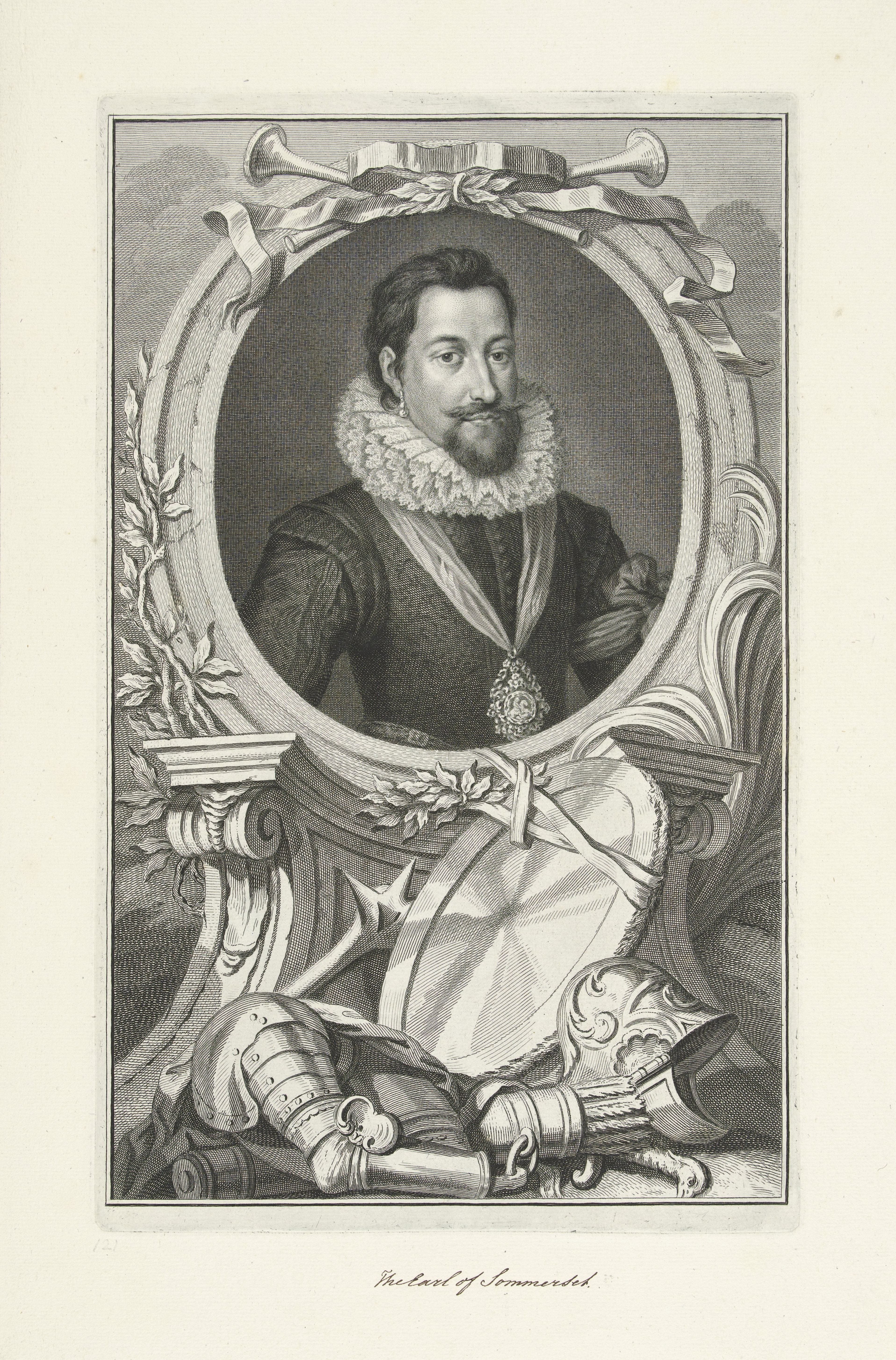
Robert Carr, Earl of Somerset, engraved by Jacob Houbraken, about 1747 to 1749. (Image: Rijksmuseum via Wikimedia Commons, CC0, https://creativecommons.org/publicdomain/zero/1.0/)
In May 1616 it was the Somersets’ turn. Frances confessed, the Society of Antiquaries notes. The DNB says both were convicted, and both were spared.
The king’s eagerness to protect them, the DNB says, encouraged a suspicion that he had known about the murder. The couple were held in the Tower and released in 1621, according to the DNB and Britannica, or in 1622, according to Higgins. Britannica adds that Carr received a full pardon in 1624 and died in obscurity in July 1645. Wikipedia gives Frances’s death as 1632.
Overbury had a kind of revenge in print. His poem A Wife had circulated in manuscript at court, where, Britannica says, it was “interpreted as an indirect attack on Lady Essex.” Published in 1614, it ran through several editions within a year. The DNB adds that his father was followed in the street by crowds calling, “There goes Sir Thomas Overbury’s father,” and that an anagram of “Thomas Overburie” became famous: “O, O, a busie murther.”
Was Frances Howard guilty?
She confessed. But the story of the scheming witch-countess was largely written by her enemies. Higgins notes that the scholar David Lindley, in The Trials of Frances Howard (1993), argued that historians often reproduce seventeenth-century gender biases when they write about her.
The records are tangled too. Higgins warns that the archive preserves “multiple, differing accounts of the same events,” and many reasons to read them as biased and misleading. Some confessions were obtained by torture. Like the Roman poisoner Locusta and the Borgias, whose story we told in our look at the Borgias and the Vatican, Frances Howard comes down to us largely through the words of her accusers.
What is not in doubt is that a man was locked in the Tower to clear the way for a marriage, and that he did not come out.
Your turn
Do you think King James knew more about Overbury’s death than he admitted? Tell us in the comments.
Coming this week and next for paid subscribers: the Count of Saint-Germain, the man Voltaire called “a man who never dies,” the owners and failed codebreakers of the Voynich Manuscript, and on Sunday Nicolas Flamel, the Paris scribe who became the most famous alchemist in history. Subscribe to Historic Mysteries to read them all and the full archive.
Historic Mystery
Sources
Sidney Lee, “Overbury, Thomas,” Dictionary of National Biography, 1885 to 1900, vol. 42, Wikisource: en.wikisource.org
John Higgins, “’Servant obedience changed to master sin’: Performance and the Public Transcript of Service in the Overbury Affair and The Changeling,” Journal of Early Modern Studies 4 (2015), pp. 231 to 258, Firenze University Press: oajournals.fupress.net
“The poisoning of Sir Thomas Overbury,” Society of Antiquaries of London, collections highlights: sal.org.uk
“Sir Thomas Overbury” and “Robert Carr, earl of Somerset,” Britannica: britannica.com, britannica.com
“Thomas Overbury,” “Frances Carr, Countess of Somerset,” and “Anne Turner (murderer),” Wikipedia: en.wikipedia.org, en.wikipedia.org, en.wikipedia.org
Image: William Larkin, Frances Howard, Countess of Somerset, about 1615, National Portrait Gallery, London, via Wikimedia Commons (public domain): commons.wikimedia.org
