


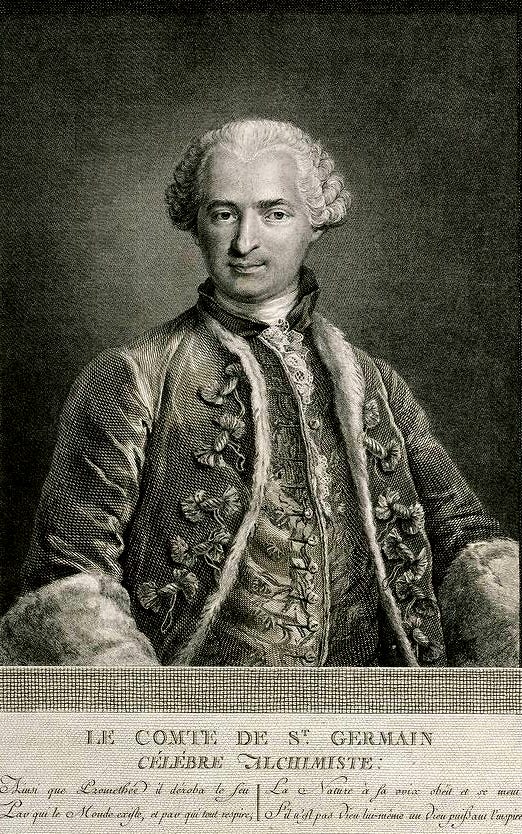
On 15 April 1760, Voltaire sat down to write to Frederick the Great, King of Prussia. Europe was at war, and peace talks were in the air. The Duc de Choiseul, Count Kaunitz and William Pitt, Voltaire wrote, did not tell him their secret. People said it was known only to a certain Monsieur de Saint-Germain.
This Saint-Germain, Voltaire went on, had once dined in the city of Trent with the Fathers of the Council, and would probably have the honor of meeting the king in about fifty years. Then came the line that outlived both men. In our translation: “He is a man who never dies, and who knows everything.”
Voltaire was being sarcastic. But the man he was mocking had told that very story at Paris dinner tables, and plenty of people believed it.
Who was he? And how did a man buried in 1784 become, a century and a half later, a spiritual Master said to appear on a California mountain?
A man who would not say who he was
The first solid sighting comes from London. On 9 December 1745, during the Jacobite rising, Horace Walpole sent the latest gossip to Sir Horace Mann.
“The other day they seized an odd man, who goes by the name of Count St. Germain,” Walpole wrote. “He has been here these two years, and will not tell who he is, or whence, but professes that he does not go by his right name. He sings, plays on the violin wonderfully, composes, is mad, and not very sensible.”
Nobody could place him. Walpole listed the rumors: an Italian, a Spaniard, a Pole, a priest, a fiddler, “a vast nobleman.” Nothing was proved against him, and he was released.
The fiddler part was real. Wikipedia, drawing on David Hunter’s study in The Musical Times, says the count wrote some of the songs for an opera staged at the Haymarket in London that same year.
The dinner guest who did not eat
By about 1748, Britannica says, Saint-Germain was at the French court, where he was employed on secret missions by Louis XV.
Our best witness from these years is another famous adventurer. Giacomo Casanova met him in Paris, in 1757 according to Wikipedia’s reading of the memoirs, at a dinner with Madame de Gergi, who brought the count along. “This individual, instead of eating, talked from the beginning of the meal to the end,” Casanova wrote. “It may safely be said that as a conversationalist he was unequalled.”
Casanova had no illusions about him. He called the count a “marvel” who “always aimed at exciting amazement.” He had won the favor of Madame de Pompadour, who spoke of him to the king. Louis XV, “a martyr to boredom,” gave him a suite of rooms at the château of Chambord and a hundred thousand francs to build a laboratory, where the king amused himself by making dyes.
Then there were the claims. “This extraordinary man, intended by nature to be the king of impostors and quacks, would say in an easy, assured manner that he was three hundred years old, that he knew the secret of the Universal Medicine, that he possessed a mastery over nature, that he could melt diamonds,” Casanova recalled.
At another dinner, at the house of the wealthy Madame d’Urfé, Casanova says the count told a story with “a face of imperturbable gravity” about something that happened while he was dining with the Fathers of the Council of Trent. Casanova burst out laughing. It is the same dinner Voltaire would joke about a few years later.
And still Casanova could not dismiss him. “In spite of my knowledge of what he was and in spite of my own feelings,” he admitted, “I thought him an astonishing man as he was always astonishing me.”
So here was the puzzle in 1760. A man with no known name, family or source of money was dining with a king’s mistress and running a royal laboratory. That spring, one of his missions for the king would go badly wrong, and within weeks he would be running from an arrest warrant under a new name.
And at the end of his road, in a small town on the Baltic, a church clerk would write down something no immortal should ever leave behind.
This is a paid post. The rest of the story, including the failed peace mission, the night Casanova watched him make gold, the prince who took him in, the death record, and how a buried man became a spiritual Master, continues below for paid subscribers. Subscribe to Historic Mysteries to read it and the full archive.
