

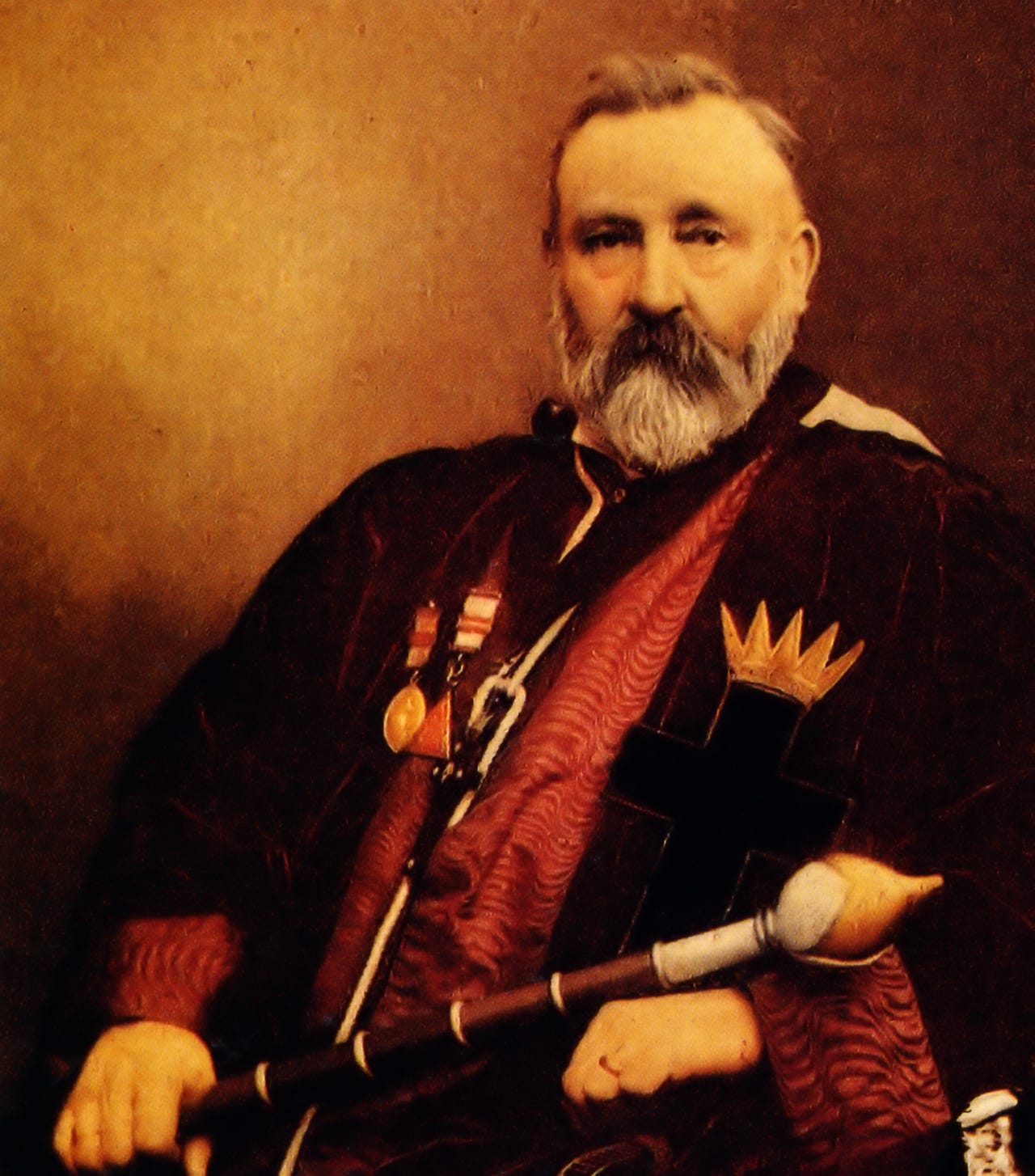
At about 11.30 on the morning of Thursday, 19 April 1900, a young man walked past the clerk in a shop at 36 Blythe Road, West Kensington, and made for the rooms upstairs. One of the men who stopped him wrote down what he was wearing. He arrived “in Highland dress, a black mask over his face, and a plaid thrown over his head and shoulders, an enormous gold or gilt cross on his breast, and a dagger at his side.”
The visitor was Aleister Crowley, then 24. The witness was Edward Hunter, a member of the Hermetic Order of the Golden Dawn. Standing beside Hunter, telling Crowley he had no right to be there, was the poet W. B. Yeats.
What Crowley wanted was upstairs. The rooms held the order’s Vault of the Adepts, a full-size ritual copy of the legendary tomb of Christian Rosenkreuz, built by Samuel Liddell MacGregor Mathers and his wife, the artist Moina Mathers. Two days earlier Crowley and a fellow member, Elaine Simpson, had forced the doors, fitted new locks and announced that they held the place on Mathers’s authority. Now he was back, masked and armed.
None of this is legend. The Golden Dawn was a real Victorian society, and its papers survive at the Museum of Freemasonry in London, which bought the archive in 2008. Its members included Yeats, the actress Florence Farr, the Irish revolutionary Maud Gonne and the writer Arthur Machen.
But the scuffle on Blythe Road was about more than a locked door. Underneath it lay a bigger question: did the order have any right to exist at all?
A coroner and a cipher
The Golden Dawn’s founders were three Freemasons: William Wynn Westcott, William Robert Woodman and Mathers. The Museum of Freemasonry dates the founding to 1888. All three belonged to the Societas Rosicruciana in Anglia, a Masonic Rosicrucian society. Our earlier post on the Rosicrucians explains where that seventeenth-century brotherhood came from.
Westcott was the engine, a London coroner by profession and an occultist by passion. Around 1887 he came into possession of a bundle of papers in code, now called the Cipher Manuscripts. Decoded, they gave outlines for a set of graded initiation rituals and a course of study in Kabbalah, astrology, tarot and alchemy.
How Westcott got the papers was never pinned down. One account traced them to the estate of the Masonic scholar Kenneth Mackenzie, who died in 1886. The historian Robin Douglas notes that “the most romantic version” had them turning up at a bookseller’s on Farringdon Road.
Then came the crucial detail. Tucked among the pages, Westcott said, was a note naming a senior adept in Germany, Fräulein Anna Sprengel, motto Sapiens Dominabitur Astris, a chief of an order called die Goldene Dämmerung, the Golden Dawn. Westcott wrote to her. She wrote back, and in the letters that followed she granted him permission to found an English branch.
That permission was the order’s pedigree. The first lodge, the Isis-Urania Temple in London, was styled “No. 3,” as if two earlier lodges already existed. By the mid-1890s Wikipedia counts more than a hundred members.
The poet, the actress and the masked man
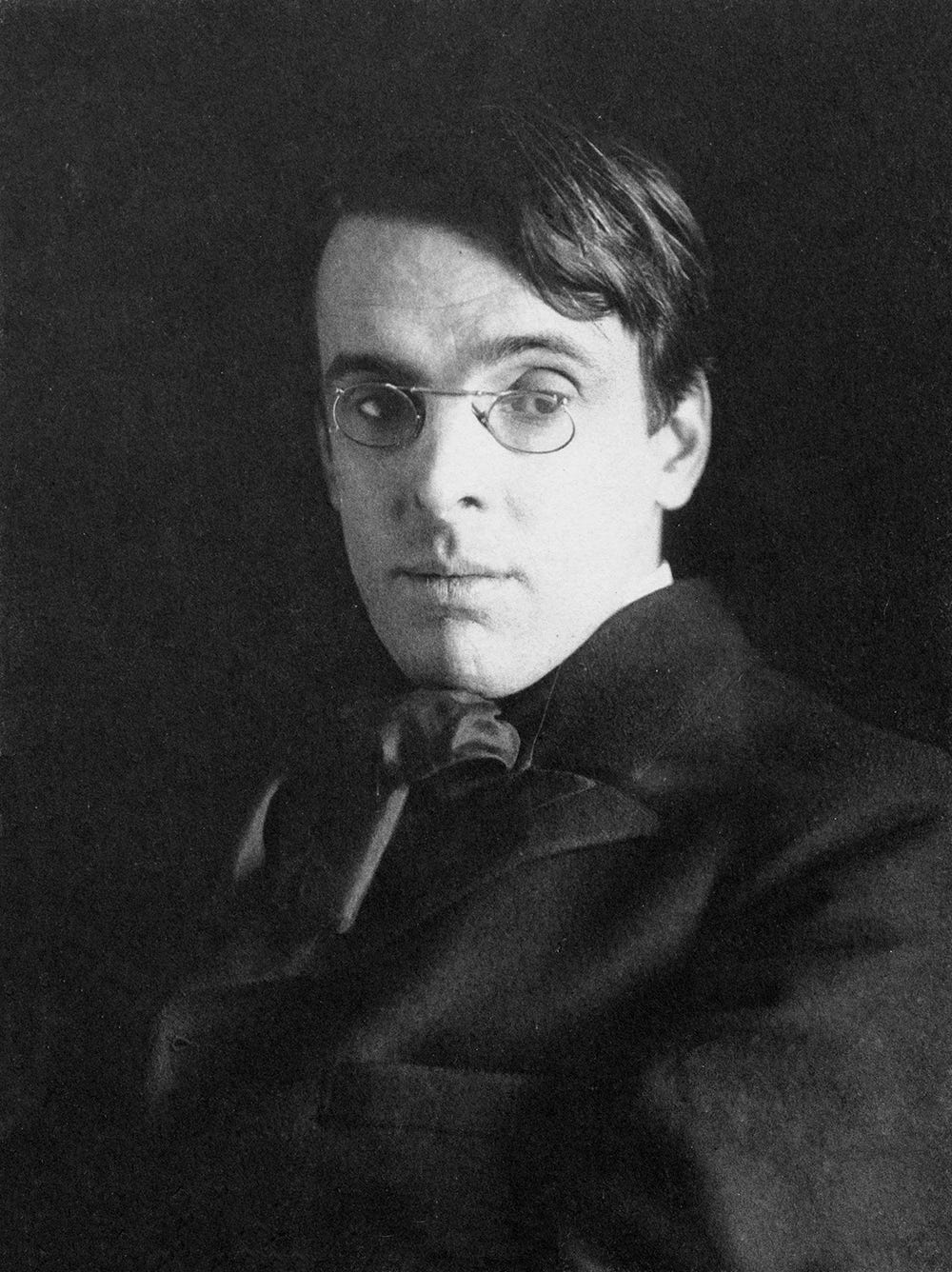
Yeats was admitted in 1890 and took the motto Daemon est Deus inversus. In July 1890 he initiated Florence Farr. Mathers, meanwhile, wrote the rituals for an inner order, and in 1891, according to the Museum of Freemasonry, practical magic began.
Then, around 1890, the German letters stopped. Westcott told members that Sprengel had died and that her colleagues disapproved of the English order and wanted no further contact. In 1892 Mathers announced that he had made his own contact with the order’s unseen masters, the Chiefs.
Westcott stepped away in 1896 or 1897, under pressure over his job as a Crown coroner. One story, which Wikipedia labels speculation, says he left occult papers in a hansom cab and his employers found out. Mathers, now living in Paris, made Farr his representative in London.
Into this walked Crowley. He was initiated on 18 November 1898 at the Isis-Urania Temple, held at Mark Masons Hall, and took the name Frater Perdurabo. He climbed quickly, made enemies and asked to join the inner order. The London adepts refused. Mathers overruled them and initiated Crowley himself in Paris on 16 January 1900.
For Farr, that was the end. She wrote to Mathers offering to resign as his representative. His reply, according to her biography, claimed that Westcott had forged the founding documents of the order.
Yeats and Farr wrote to Westcott at once and asked him to answer the charge. If Mathers was telling the truth, the order that Yeats had given ten years of his inner life to was built on a fake. The one living man who could settle it was Westcott, and his answer settled nothing. Settling it would take another 111 years, a historian’s eye and one word of German grammar.
This is a paid post. The rest of the story, including what the cipher papers really reveal, the grammar slip that exposed the Sprengel letters, the full account of Crowley’s raid on Blythe Road and how the order tore itself apart, continues below for paid subscribers. Subscribe to Historic Mysteries to read it and the full archive.
