

On 11 and 12 October 1786, officials in the Bavarian town of Landshut searched the house of a former government councilor named Zwack. They were looking for proof that a secret society existed. They found a great deal more.
According to the American scholar Vernon Stauffer, who studied the affair in 1918, the haul included more than two hundred letters between the society’s founder and its leading members, tables of secret symbols, a secret calendar and code names for places, imprints of its seals, a partial roster of members, its statutes, instructions for recruiters and the ceremony of initiation.
Then the Bavarian government did something unusual. It printed the lot. In 1787 the papers came out as Einige Originalschriften des Illuminatenordens (”Some Original Writings of the Illuminati Order”), so that anyone who read German could see what the secret society had been telling itself.
Stauffer describes the effect. By the admissions of its leaders, he writes, the order had “the appearance of an organization devoted to the overthrow of religion and the state.” The publication “amounted to nothing less than a sensation.”
The society was the Illuminati. The Gotha Research Centre at the University of Erfurt says it “can probably be described without exaggeration as the most notorious secret society of all time.” Yet it is also one of the few secret societies that we can read in its own words.
So we do not have to ask whether the Illuminati existed. They did, and they have a birthday: 1 May 1776.
The professor from Ingolstadt
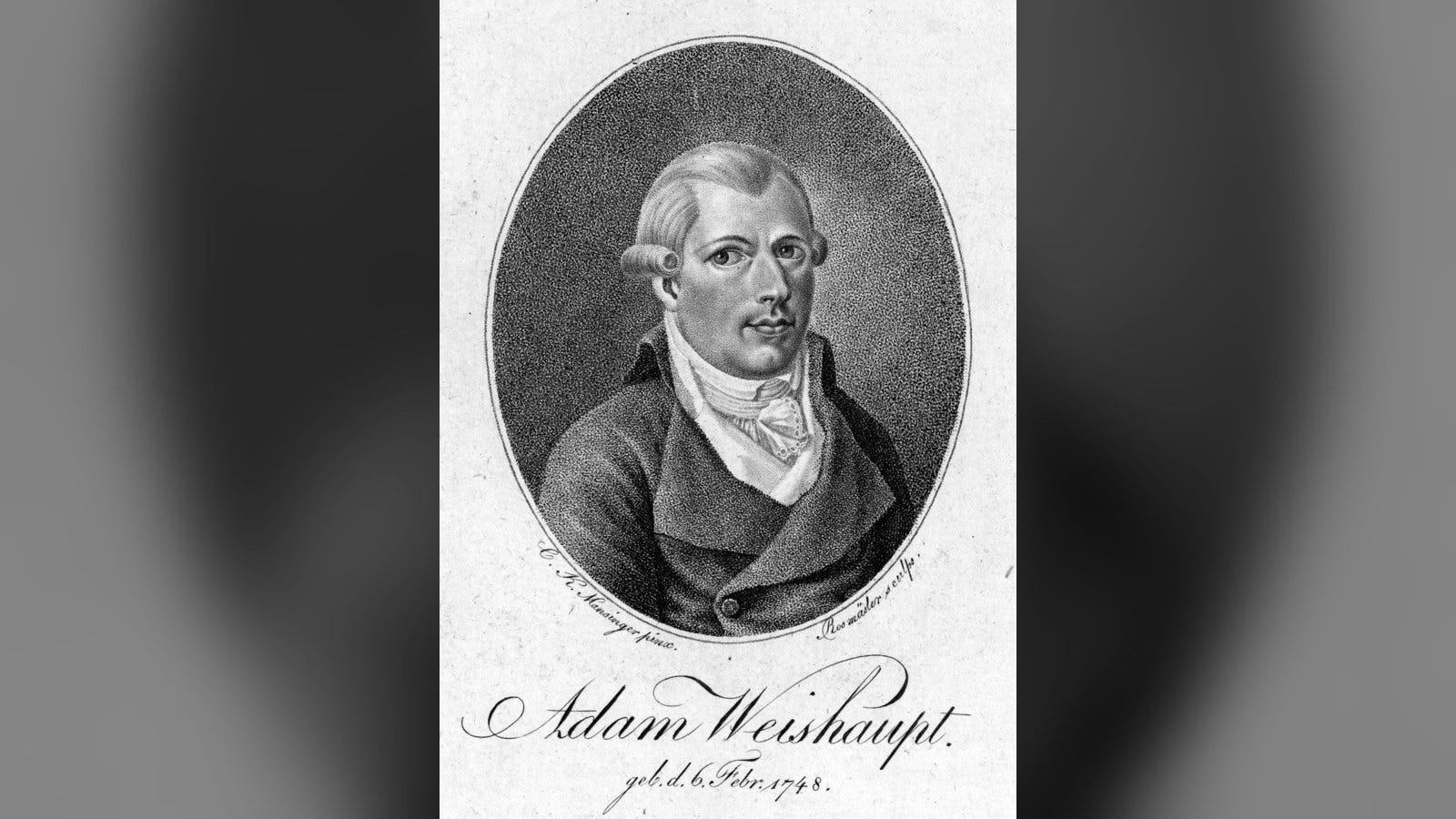
The founder was Adam Weishaupt, born in Ingolstadt on 6 February 1748. According to Wikipedia, he became professor of canon law and practical philosophy at the University of Ingolstadt in 1773, at the age of 25. He was the only non-clerical professor at a university run by Jesuits, whose order the pope had dissolved that same year. The Jesuits of Ingolstadt, however, still held the purse strings and much of the power.
Weishaupt became deeply anti-clerical. On 1 May 1776 he and four of his students formed a secret group they called the Perfectibilists, with the owl of Minerva as their symbol. Everyone took an alias. Weishaupt became “Spartacus,” after the leader of the Roman slave revolt. His four law students became Ajax, Agathon, Tiberius and Erasmus Roterodamus. In April 1778 the name changed to the Order of the Illuminati.
Why a secret society at all? Weishaupt gave his own answer in a passage Wikipedia quotes. At a time when there was no end of making game of and abusing secret societies, he wrote, he “planned to make use of this human foible for a real and worthy goal.”
The goal, as Munich’s Ludwig Maximilian University summarizes it, was to build up, through education and surveillance, an elite of men who would in time take over key positions in the state. The order had grades, starting with Novice and Minerval. According to Wikipedia, it ran a system of mutual espionage that kept Weishaupt informed about the activities and character of every member.
Picture it in 1776. A young professor, in a Catholic state ruled by a prince-elector, was recruiting students into a hierarchy that answered to him, handing out code names and collecting reports on his own followers.
The order started small. By the end of the summer of 1778 it had just 27 members in five “commands,” each named after a city of ancient Greece: Munich was “Athens” and Ingolstadt was “Eleusis.” Favored recruits, according to Wikipedia, were rich, docile, willing to learn and aged 18 to 30.
Then it grew. It acquired lodges, members across the German states, and powerful protectors. By the middle of the 1780s it was also being watched.
By 1787 the order had been banned in Bavaria, Weishaupt was in exile and his papers were in print.
Ten years later, a French priest and a Scottish professor each published a book claiming that the order had not been broken at all. It had gone underground, they said, and caused the French Revolution.
One of the two stories was history. The other was the beginning of a legend that is still being sold today.
This is a paid post. The rest of the story, including the confession Weishaupt had to make to his star recruiter, the real numbers, what actually survived the raids, and the verdict on “was it really crushed?”, continues below for paid subscribers. Subscribe to Historic Mysteries to read it and the full archive.
